Say it once.
Go home on time.
Describe the study out loud, the way you'd say it to a colleague. A draft report comes back written out in your own template — for you to review, correct and sign.
Free plan · No card required to sign up · Every report stays a draft until you sign it

Dictated: HRCT chest, plain. Subpleural reticulation both lower lobes, mild traction bronchiectasis. Early honeycombing at both bases. No pleural effusion. Impression — fibrosing interstitial lung disease, basal predominant, progressed since the March study.
An illustration only, and not a real report. Drafts are written from what you dictate, and are reviewed, corrected and signed by you.
Why radiologists use it
The reading stays yours. The typing stops being yours.
You decide what the study shows and what the impression says. What changes is everything after that — the writing out, the formatting, the second pass at midnight.
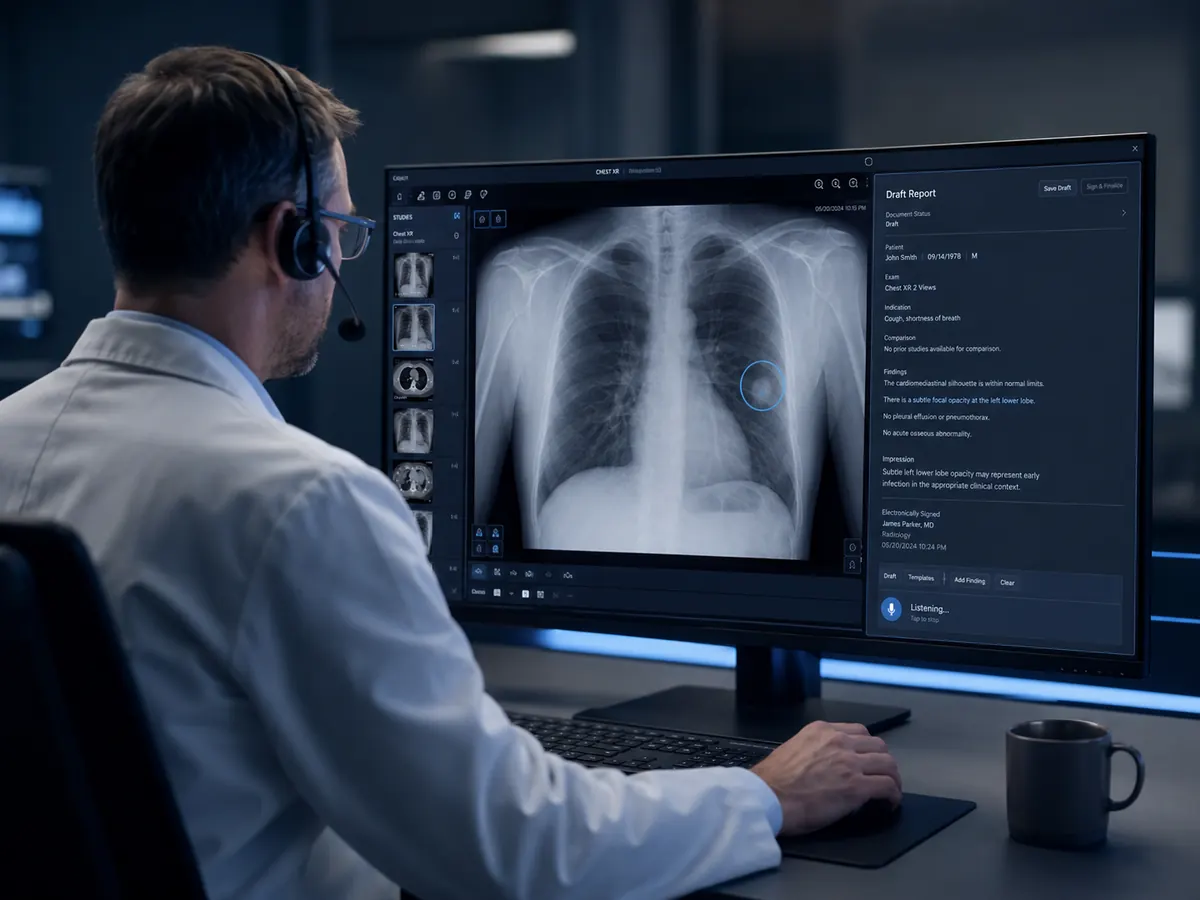
The typing goes away
Say what you see, in your own words and your own order. The draft comes back written out under your headings, rather than as fragments you have to assemble.
It follows your template
Drafts are laid out using the templates and headings you set up, so there is less to reformat before the report leaves your desk.
Less of the list comes home with you
The draft is ready while the study is still in front of you, so there is less left to dictate once the reading is done.
Earlier studies stay within reach
Your earlier reports sit alongside the one you are working on, so comparing with a previous study doesn't mean going hunting for it.
How it works
Three steps, and none of them are typing
Speak
Open the study and describe it out loud, the way you would to a colleague across the desk. Pause, correct yourself, go back — it keeps up.
Review
The draft appears in your template. Change any line, add anything, remove anything. It stays a draft, and yours to correct, until you approve it.
Sign
Nothing is filed, sent or shared until you approve it — and the doctor who signs the report remains responsible for what it says.
Where you stay in control
A documentation tool, not a second opinion
You review and sign
Scanexsa writes drafts. It does not diagnose, recommend or decide, and no report is final until a licensed doctor has checked and approved it.
Your data stays yours
The reports you create belong to you and your organisation. Your data is not sold, and is not used for advertising or to train models.
Encrypted, in transit and at rest
Data is encrypted on the way to us and while it is stored. If your practice needs a Business Associate Agreement, ask us for one.
Read the next study, and see what comes back.
Setting up takes a few minutes. Start on the free plan, with your own cases, and decide from there.